
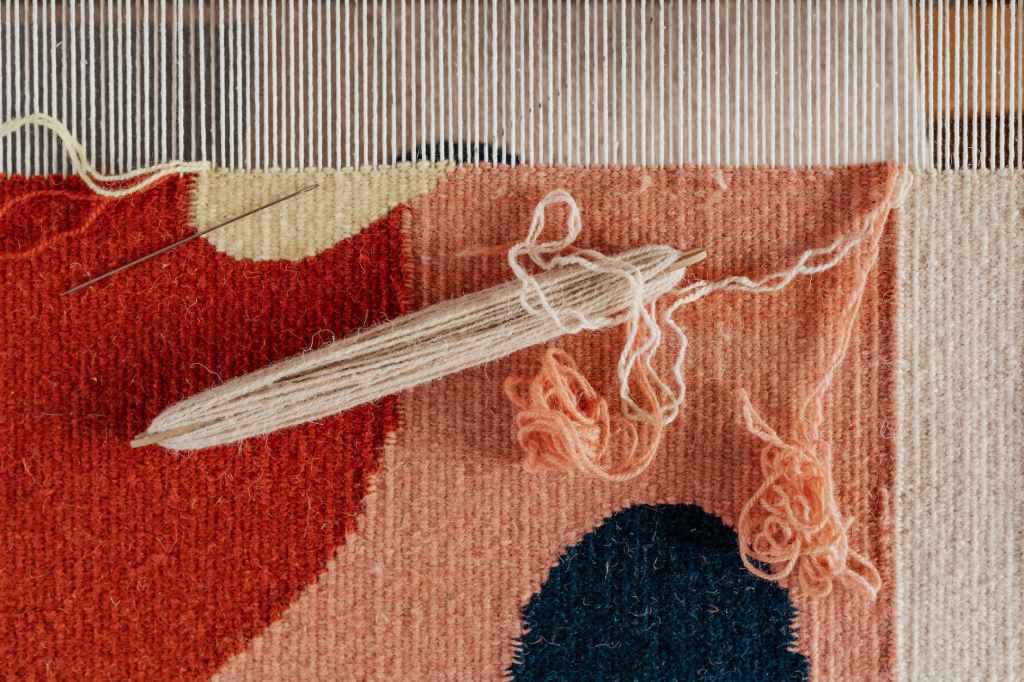
Learning to weave is fun and is often the begining of experimentation of materials in textile art. Take it from me, do not buy a loom, use a sturdy picture frame and learn to make knots (see below to structure your tapestry) and if you can afford it then google Tapestry courses near you. It is an investment that will greatly benefit you.
This is a fun post for people who are curious to learn, YouTube has some ok tutorials and there are some ok courses online. The best way to learn is with a tapestry artist, we have great textile artists in Ireland – all searchable on google.
Materials needed:
- Frame loom
- Warp thread (strong thread or string)
- Weft thread (yarn, wool, or other desired material)
- Tapestry needle
- Scissors
Steps:
- Set up the warp threads on the frame loom. Tie one end of the warp thread onto the top corner of the frame, then wrap the thread tightly around the top and bottom bars of the frame. This will create the foundation of the weaving. Once you reach the other end of the frame, tie the thread off onto the opposite top corner. (For a better structure to your tapestry then start your tapestry with a double half-stitch knot.)
- Start weaving the weft thread. Cut a length of weft thread and tie it onto the bottom warp thread using a knot. Bring the needle up and over the first warp thread, then go back under the next warp thread, over the next, and so on. This is called the “over-under” pattern, and it creates the first row of the weaving.
- Push the weft thread down towards the bottom of the frame using a comb or your fingers. This is called “packing the weft”, and it helps to create a tight, even weave.
- Continue weaving rows of the tapestry, following the “over-under” pattern. Change colors or materials as desired, or create different patterns by varying the number of weft threads between each warp thread.
- Create shapes and designs within the tapestry by adding or removing weft threads as needed. Use the needle to pull weft threads up or down, or to create different patterns within the weaving.
- Finish the tapestry by tying off the final weft thread onto the bottom warp thread, and then removing the weaving from the frame loom. Trim any excess warp threads or loose ends.
- Optional: add a backing to the tapestry using fabric or felt to protect the back of the weaving.
Using a frame loom to weave a tapestry can be a fun and rewarding project. With practice, you can create intricate designs and patterns within the weaving, and experiment with different colours and materials to create unique pieces of art.
 Cork Textiles Network